Notes on Daily Foot Comfort
|
What this covers
|
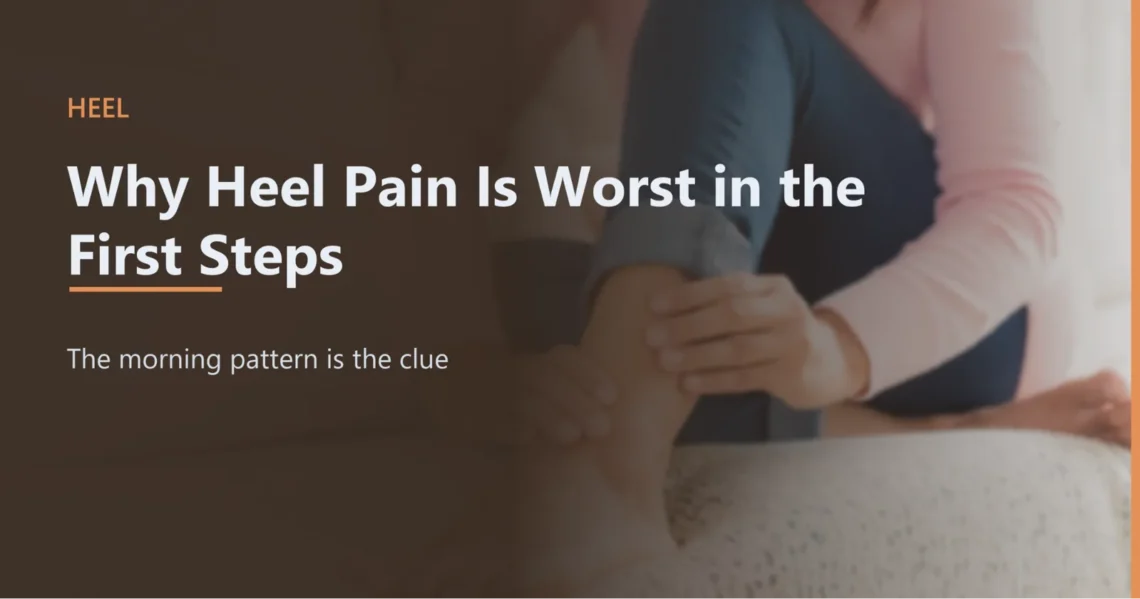
The pattern is unmistakable once you have had it. The first few steps out of bed are sharp and sore under the heel, it eases after a few minutes of walking, and it returns after any period of sitting still.
That pattern is the most recognizable feature of plantar heel pain, and it is also the most useful clue about what is going on. Understanding why the morning is the worst part explains why the usual response of stretching it does not reliably help, and what does.
What the Plantar Fascia Does
A thick band of connective tissue runs along the sole of the foot, from the heel bone forward toward the toes. It supports the arch and it helps the foot behave like a rigid lever when you push off.
The condition usually called plantar fasciitis involves this tissue becoming painful where it attaches at the heel. As with tendon problems elsewhere, the suffix implying inflammation has fallen out of favor, because the tissue changes found are more degenerative than inflammatory. Plantar fasciopathy or plantar heel pain are increasingly used instead.
That is not a semantic point. It changes what the treatment should be, because a tissue that has lost load tolerance needs loading rather than calming.
Why the Morning Is the Worst Part
Overnight the foot rests in a relaxed position with the toes pointed slightly down, and the fascia sits in a shortened state for several hours. Nothing is loading it and nothing is lengthening it.
The first steps of the day apply full body weight to tissue that has been still all night. The tissue is asked to go from no load to maximum load in a single step, with no transition. That is the sharp pain people describe.
Within a few minutes the tissue accommodates and the pain reduces, which is why walking helps. The same thing happens in miniature after any long period of sitting, which is why standing up after a meeting hurts in the same way.
|
When it hurts |
What is happening |
|
First steps in the morning |
Full load applied to tissue that has been unloaded for hours |
|
After sitting for a while |
A smaller version of the same transition |
|
Easing after a few minutes |
The tissue accommodating to load |
|
Later in a long day on your feet |
Accumulated load rather than a cold start |
|
At rest, constantly |
Less typical, and worth getting assessed |
The last row matters. Pain that is present constantly, including at rest and at night, does not fit this pattern and deserves a look rather than more stretching.
Why Stretching Alone Often Stalls
Almost everyone with this condition stretches, because it is the obvious response and because the tissue feels tight.
Stretching generally helps the morning symptom. It makes the first steps more bearable, and that is a genuine benefit. What it rarely does on its own is resolve the condition, and people who stretch diligently for months and see no underlying change are a common story rather than an unusual one.
The reason is the same as for tendon problems elsewhere. Stretching changes how the tissue feels in the short term. It does not raise the tissue’s capacity to tolerate load, and the capacity is what has dropped. Loading the tissue deliberately and progressively is what addresses that, and it is the part most people never reach.
What Loading Looks Like for a Foot
Progressive loading for the plantar fascia usually centers on calf and foot strength work, performed slowly, with the toes positioned so the fascia is under tension.
- Slow, heavy calf raises are the usual backbone, performed with control rather than for speed
- A towel or rolled cloth under the toes puts the fascia on stretch while the calf works
- The weight increases over weeks as tolerance builds
- Some discomfort during the work is generally acceptable
- Pain that climbs through the next day suggests the step was too large
This is deliberately unglamorous and it takes months rather than weeks. The pace is set by how connective tissue remodels, which is slower than muscle and not something willingness can accelerate.
The Things Worth Changing Immediately
While the loading work is underway, some straightforward adjustments reduce how hard the tissue is working each day.
|
Change |
What it does |
|
Avoid long barefoot spells on hard floors |
Removes repeated unsupported loading at home |
|
Supportive footwear from the first step out of bed |
Softens the morning transition |
|
Break up long standing blocks |
Reduces accumulated load rather than peak load |
|
Reduce hill and speed running for a period |
Both raise demand on the push-off phase |
|
Consider a heel pad or an off-the-shelf insert |
Can reduce symptoms while capacity rebuilds |
Footwear at home is the one people overlook most. Someone who wears supportive shoes to work and then spends four hours barefoot on tile in the evening has undone a good part of the day.
Inserts are worth a word. They often help symptoms and they are a support rather than a cure, because they reduce demand without raising capacity. Used alongside loading work they are useful. Used instead of it, the problem usually waits.
Where It Shows up Around Rogers
Rogers has a substantial amount of walking and running close to town, with trails around Lake Atalanta and the long paved greenway that runs the length of Northwest Arkansas. The local pattern is a mix of hard pavement and unpaved trail, often in the same outing.
That mix is generally good for feet, because varied surfaces vary the load. What tends to cause trouble is a sudden shift in the balance, most often in spring when people move from limited winter activity to considerably more. A foot that handled a quiet February is being asked to handle a different April.
The same applies to work. A change from a seated role to one on your feet, or a season of yard work after a winter indoors, is a change in load even though nobody would describe it as training.
What Else Produces Heel Pain
Not all heel pain is plantar fascia pain, and a few alternatives behave differently enough to be worth separating.
Pain at the back of the heel rather than underneath points toward the Achilles tendon and its attachment. Pain with numbness, burning or pins and needles suggests nerve involvement. Pain that is constant, present at rest and not following the morning pattern sits outside the usual picture, as does heel pain in a child or adolescent, which has its own common cause related to growth.
An assessment separates these, and it matters because loading a structure that is not the source produces months of diligent work and no improvement.
How Long It Reasonably Takes
This condition is slow, and expectations are where people most often come unstuck. Improvement is usually measured across months, and progress is uneven rather than linear.
The most common error is stopping the loading work when the morning pain goes. Symptoms settle before capacity returns, and a foot that feels fine on a normal day has not been tested by a long one. Carrying the strength work past the point where it feels necessary is what prevents the second episode.
What to Make of a Heel Spur
At some point many people with this condition are shown an image with a bony projection at the heel and told they have a heel spur. It is usually presented as the explanation, and it usually is not.
Heel spurs are common in people with no heel pain whatsoever. They are also absent in plenty of people whose heel pain is severe. A finding that appears in both groups cannot be the thing that separates them.
The current understanding is closer to the reverse of the intuitive story. The spur is generally regarded as a consequence of long-term load through the area rather than a spike digging into tissue. Removing it is not the standard approach, and symptoms frequently resolve with the spur still there.
This matters because of what the explanation does to the person. Being told there is a bony growth in your heel invites the conclusion that the problem is structural, permanent and only fixable by a procedure. That belief reliably reduces how much someone is willing to load the foot, and loading the foot is the treatment.
The useful reframe is that the image shows a long-standing pattern of load, which is information about history rather than a target. What changes the symptoms is building the tissue’s tolerance back up, which is the same answer whether or not a spur is visible.
The same caution applies to thickness measurements of the fascia on ultrasound. They can be a useful marker over time, and they correlate poorly enough with how much it hurts that a number alone is a bad guide to whether someone is getting better.
Where Assessment Happens Locally
Clinic groups such as Advanced Physical Therapy provide physical therapy for foot and heel pain in Rogers from West Hudson Road. Their page on how foot and ankle problems are assessed covers what an examination separates out, and the clinic is listed on a Google Business Profile.
The morning pattern is worth paying attention to, because it is both the symptom and the explanation. A tissue that hurts going from nothing to everything in one step is telling you what it needs, and it is not another stretch.

You May Also Like

Over 5 Billion on Social Media, but at What Cost? Experts Warn of Cyberbullying’s Lingering Impact on Youth

Common Mistakes When Using a Woodworking Respirator And How to Avoid Them
