Health
-
What Happens in the Body During a Hangover
What this covers Mechanism One: Fluid Loss, and the Reason It Is Disproportionate Mechanism Two: A Byproduct the Body Has to Clear Mechanism Three: Congeners, Which Make the Drink Matter Mechanism Four: Sleep That Does Not Count How the Drink Itself Changes the Arithmetic Why They Need Separating The Symptom That Outlasts Rehydration Where the Day Puts Pressure on Recovery What an Infusion Is Doing When It Is Not a Hangover Why the Remedies Market Is so Crowded A hangover gets treated as a single condition with a single cause, and it is neither. It is at least four separate processes running at once on different timelines, which is why…
-
A New Path to Healing? VA Studies MDMA Therapy for Veterans with PTSD
Photo By: Noah Silliman The U.S. Department of Veterans Affairs is taking a new step in the search for better mental health treatments for veterans. The agency has launched a clinical trial to study whether MDMA-assisted therapy can help veterans living with post-traumatic stress disorder (PTSD) and alcohol use disorder. The study will include about 80 veterans who struggle with both conditions. Researchers want to learn if MDMA, when used during guided therapy sessions with trained professionals, can reduce PTSD symptoms and help participants better manage alcohol addiction. MDMA is best known as the illegal street drug sometimes called “ecstasy” or “molly.” In this study, however, it will only be used in…
-
Depression Treatment in NY and NJ, How the Decisions Are Actually Made
Most patients starting depression treatment are given a brief explanation of two or three medication options and then asked which one they prefer. That is not how the decision is actually made by experienced psychiatrists, and the gap between the brief patient-facing explanation and the underlying clinical reasoning matters because it changes outcomes. For anyone starting treatment for depression, here is the more honest version of how a good clinician chooses the first treatment, when they change course, and what the year ahead usually looks like. What to know • First-line medication choices for depression are based on a structured weighing of symptom profile, prior personal and family medication history,…
-
The Burnout Crisis in Healthcare — And Why Secure AI May Be Part of the Solution
More than 65% of nurses report experiencing high levels of stress and burnout, according to a national survey conducted by Florida Atlantic University. The findings reinforce a growing concern across the healthcare sector: workforce strain remains widespread, and administrative complexity continues to weigh heavily on clinicians. Burnout is no longer viewed solely as a staffing shortage issue. Increasingly, healthcare leaders describe it as a systems-level problem — one driven in part by documentation demands, compliance requirements, and digital workflow inefficiencies. The American Medical Association has repeatedly identified excessive documentation and regulatory burden as leading contributors to physician burnout. Research published within the JAMA Network has linked time spent in electronic…
-
VA Rule Change Could Put Veterans’ Health and Benefits at Risk
A controversial rule change from the Department of Veterans Affairs that took effect on February 17, 2026, has sparked outrage among veterans, advocates, and supporters across the country. The new interim final rule changes how the VA calculates disability ratings for veterans who receive compensation for service-connected injuries and illnesses. Under the rule, VA examiners will now determine ratings based on how well a veteran functions while taking medication or receiving treatment. Previously, disability ratings reflected the severity of a condition without considering whether it was being managed with treatment. The VA says the rule is meant to provide a clearer picture of how a veteran manages daily life. Many…
-
How Microbial Imbalances Influence Mood and Motivation
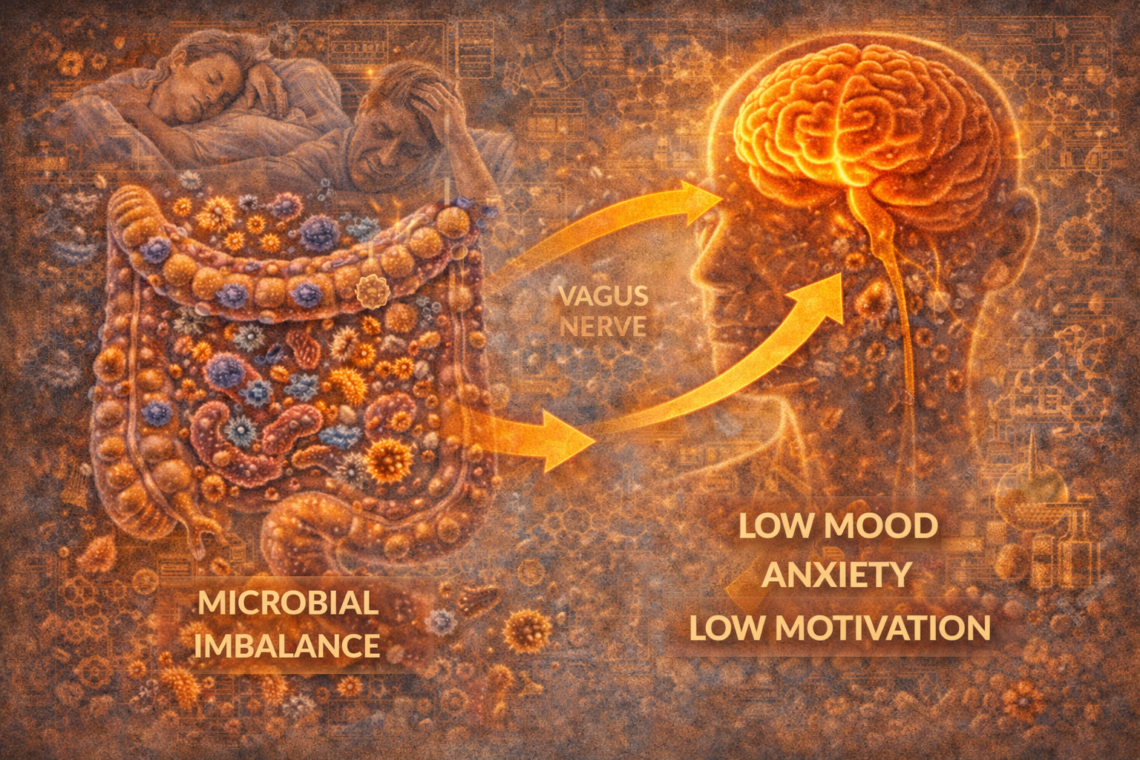
For much of modern medicine, the brain and the gut were treated as separate systems. Mental health was studied through neurotransmitters, cognition, and psychology, while digestion was viewed as a mechanical process of nutrient breakdown and absorption. Over the past two decades, this separation has steadily eroded. Research now shows that the gut and brain are in constant communication, influencing not only digestion and immunity, but also mood, motivation, and behavior. At the center of this relationship is the gut brain axis, a bidirectional communication network linking the central nervous system with the gastrointestinal tract and its microbial inhabitants. As understanding of this system deepens, microbial imbalance in the gut…
-
The 3-Day Shift: How I Fixed My Gait and Reclaimed My Mobility After 6 Months of Struggle
We often take the simple act of walking for granted. It is the background rhythm of our lives—an automatic, subconscious action that carries us from point A to point B. But for the last six months, walking has not been automatic for me. It has been a battle. It has been a conscious, confusing, and often painful calculation of every single step. For half a year, I lived with a body that felt like it was at war with itself. My gait was broken. My right side had become a tyrant, dominating every movement, while my left leg had become a ghost—lagging, dragging, and refusing to participate. I was misaligned,…
-
Qalitex Labs on Packaging Compatibility Testing and Its Impact on Product Safety
Packaging is often viewed as secondary to the product itself, yet it plays a silent role in keeping products safe and effective. A lotion, capsule, or beverage may be formulated with care, but if its container reacts with the product, the entire effort can collapse. In this post, we’ll discuss packaging compatibility testing, why it matters, the methods involved, and how it directly affects product safety and trust. What Is Packaging Compatibility Testing Packaging compatibility testing evaluates whether a product and its container can coexist safely over the entire shelf life. It focuses on identifying risks that may compromise safety, stability, or quality once the product is filled, sealed, and…
-
Traditional Dyslexia Methods Are Failing—Here’s the Data-Driven Approach Changing Everything!
If you’re a parent navigating concerns about your child’s reading and learning challenges, you’ve likely encountered a whirlwind of conflicting opinions and frustrating advice. Dyslexia is one of the most misunderstood learning differences today—often wrapped in myths, misinformation, and institutional red tape. What makes this more dangerous is that myths can delay action—and the longer intervention is postponed, the harder the road becomes for the child. Enter Dr. Rebecca Troy, founder of a cutting-edge dyslexia intervention that defies conventional wisdom. With her innovative approach, kids are finally making real progress in just 4 months—the kind usually promised only after years of expensive therapy or specialized schooling. In the sections below,…
-
The Myth of the “Strong Woman” Is Hurting Women Everywhere
There’s a particular image that’s been sold to women for generations. She is the “strong woman”—the one who never cries, never complains, never asks for help. She carries the weight of the world on her shoulders with quiet grace, juggling careers, caregiving, trauma, and societal expectations with no visible crack in her armour. She shows up for everyone. She holds families together. She puts herself last. And she does it all without breaking a sweat. At first glance, this might seem like a compliment. Who wouldn’t want to be seen as resilient, reliable, and tough? But behind this ideal is a deeply toxic narrative. It’s a story that tells women…