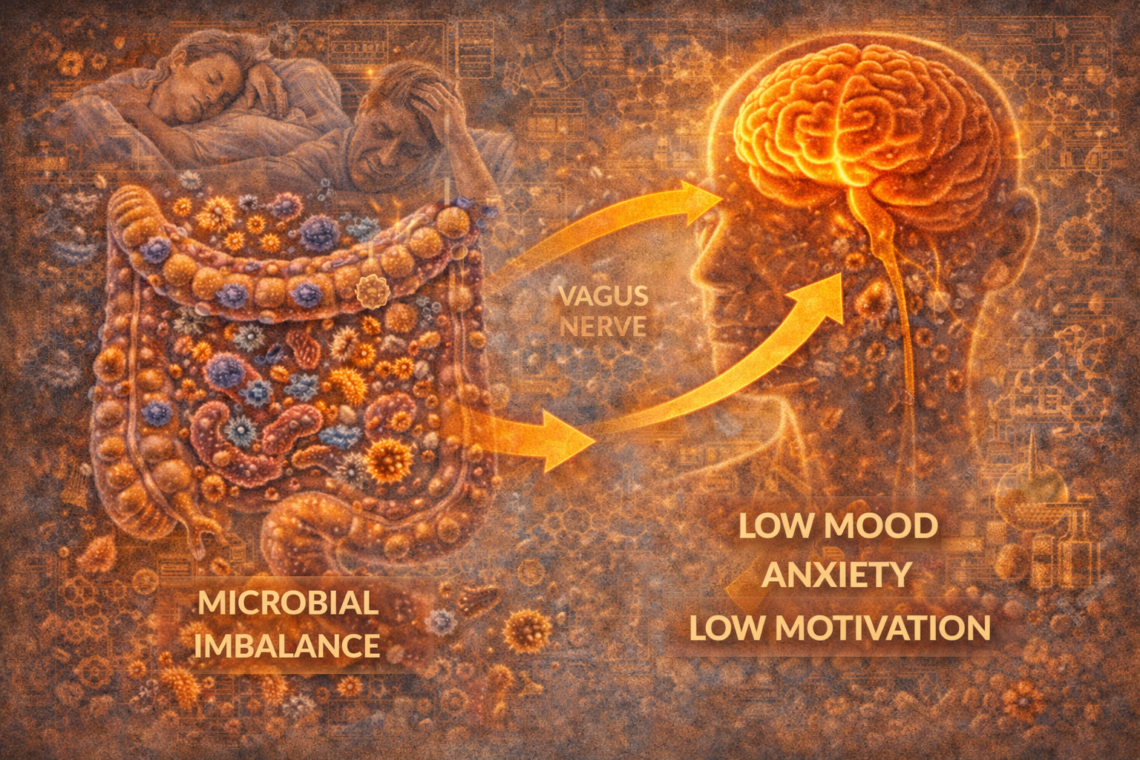
How Microbial Imbalances Influence Mood and Motivation
For much of modern medicine, the brain and the gut were treated as separate systems. Mental health was studied through neurotransmitters, cognition, and psychology, while digestion was viewed as a mechanical process of nutrient breakdown and absorption. Over the past two decades, this separation has steadily eroded. Research now shows that the gut and brain are in constant communication, influencing not only digestion and immunity, but also mood, motivation, and behavior.
At the center of this relationship is the gut brain axis, a bidirectional communication network linking the central nervous system with the gastrointestinal tract and its microbial inhabitants. As understanding of this system deepens, microbial imbalance in the gut is increasingly associated with emotional states such as low mood, anxiety, reduced motivation, and cognitive fatigue. These effects are not merely psychological. They reflect biological signaling that originates far from the brain itself.
Understanding how microbial imbalances influence mood and motivation requires examining how gut microbes interact with neural, immune, and metabolic pathways that shape mental states over time.
The Gut as a Neuroactive Organ
The gut is often referred to as the “second brain,” not because it thinks, but because it contains an extensive network of neurons known as the enteric nervous system. This system regulates digestion independently while remaining closely connected to the brain through neural, hormonal, and immune pathways.
Gut microbes interact directly with this network. They produce metabolites, neurotransmitter precursors, and signaling molecules that influence neural activity. These signals travel to the brain via the vagus nerve, immune mediators, and circulation.
This means that the brain is constantly receiving input from the gut environment. When the microbial ecosystem is balanced, these signals support emotional stability and cognitive function. When imbalance develops, signaling shifts in ways that can undermine mood and motivation.
Defining Microbial Imbalance
Microbial imbalance, often referred to as dysbiosis, does not imply the presence of a single harmful organism. Instead, it reflects altered diversity, disproportionate populations, or loss of beneficial species within the gut microbiome.
Modern factors such as highly processed diets, chronic stress, sleep disruption, medications, and reduced dietary fiber contribute to these shifts. Dysbiosis alters microbial metabolism, affecting what compounds are produced and how the immune system responds.
Because gut microbes function collectively rather than individually, even subtle shifts in composition can change the overall signaling environment that feeds into the gut brain axis.
Neurotransmitter Production in the Gut
A significant portion of neurotransmitters associated with mood regulation are influenced by gut microbes. Serotonin, commonly associated with well-being and emotional balance, is largely produced in the gut. While gut-derived serotonin does not cross directly into the brain, it influences neural signaling and immune activity that affect brain function indirectly.
Microbes also influence the availability of precursors for dopamine and gamma-aminobutyric acid, neurotransmitters involved in motivation, reward processing, and emotional regulation.
When microbial balance is disrupted, production and regulation of these compounds may shift. This can alter signaling tone, contributing to reduced motivation, emotional blunting, or heightened stress sensitivity.
Inflammation as a Mood Mediator
One of the most consistent links between gut dysbiosis and mood involves inflammation. An imbalanced microbiome can impair gut barrier integrity, allowing inflammatory molecules to enter circulation.
These molecules influence brain function by activating immune pathways that alter neurotransmitter metabolism and neural signaling. Low-grade systemic inflammation has been associated with depressive symptoms, reduced motivation, and cognitive fatigue.
Research summarized by the National Institutes of Health highlights that inflammatory signaling originating in the gut can affect brain regions involved in mood and reward processing. This helps explain why emotional symptoms often accompany digestive or metabolic disturbances.
The Vagus Nerve and Emotional Signaling
The vagus nerve serves as a major communication highway between the gut and brain. It transmits sensory information about gut conditions directly to brain regions involved in emotional regulation.
Microbial metabolites influence vagal signaling by interacting with gut epithelial cells and immune receptors. Balanced signaling supports calm, adaptive responses. Dysregulated signaling may increase anxiety-like behavior or dampen motivation.
Animal studies demonstrate that altering gut microbes changes behavior, and that these effects often disappear when vagal signaling is interrupted. This finding underscores the biological basis of gut-driven mood changes.
Motivation, Energy, and Microbial Metabolites
Motivation is closely tied to perceived energy availability. Gut microbes influence energy regulation through production of short-chain fatty acids and other metabolites that affect mitochondrial function and metabolic signaling.
When microbial balance supports efficient energy metabolism, mental energy and motivation tend to be higher. When dysbiosis disrupts these pathways, individuals may experience low drive, fatigue, and reduced initiative. This metabolic link helps explain why motivational decline often coexists with digestive symptoms or dietary changes rather than appearing in isolation.

Stress, Microbes, and Feedback Loops
Stress does not only affect the brain. It alters gut motility, blood flow, and immune activity, all of which influence microbial composition. In turn, dysbiosis amplifies stress signaling through inflammatory and neural pathways.
This creates a feedback loop. Stress disrupts microbes, altered microbes worsen stress responses, and mood regulation deteriorates over time.
Studies discussed by Harvard Health Publishing note that chronic stress is associated with both microbial imbalance and increased risk of mood disorders, reinforcing the bidirectional nature of the gut brain axis.
Diet Patterns and Emotional Signaling
Diet strongly shapes microbial composition. Diets high in ultra-processed foods reduce microbial diversity and alter metabolite production. These changes influence inflammation and neurotransmitter-related pathways.
In contrast, diets rich in diverse, minimally processed foods tend to support microbial ecosystems associated with more stable mood signaling. This does not mean diet alone determines emotional health, but it establishes a biological context that either supports or strains regulatory systems.
Educational resources focused on metabolic and digestive health, including those available on Dr. Berg’s blog, often emphasize gut integrity and microbial balance as foundational to both physical and mental well-being.
Mood Disorders and the Gut-Brain Connection
While mood disorders are multifactorial, the gut brain axis offers insight into why symptoms often resist purely psychological intervention. Microbial imbalance may sustain inflammatory or metabolic conditions that perpetuate low mood or motivation despite cognitive therapy or medication.
This does not diminish the role of mental health care. Instead, it highlights that emotional states are shaped by both neural and physiological inputs.
Understanding this connection may help explain why some individuals experience mood improvement when digestive health improves, even without direct psychological intervention.
Microbial Diversity and Emotional Resilience
Microbial diversity appears to be associated with resilience, not only in digestion but also in emotional regulation. Diverse ecosystems produce a wider range of metabolites that support adaptive signaling.
Reduced diversity narrows this signaling range, making emotional responses more rigid and stress-sensitive. This rigidity can manifest as persistent low mood or reduced motivation.
From a systems perspective, diversity enhances adaptability, whether in ecosystems or biological signaling networks.
Rethinking Motivation as a Biological Signal
Motivation is often framed as a personality trait or mental skill. The gut brain axis reframes it as a biological signal influenced by energy status, inflammation, and microbial communication.
When internal signals suggest scarcity or threat, motivation naturally declines. This response is adaptive in acute settings but becomes maladaptive when driven by chronic microbial imbalance.
Recognizing this distinction reduces stigma and shifts focus toward restoring physiological conditions that support motivation.
Implications for Mental and Digestive Health
The growing understanding of the gut brain axis challenges siloed approaches to health. Mood, motivation, digestion, and metabolism are interconnected rather than independent.
This perspective supports integrated strategies that address gut integrity, microbial balance, and stress physiology alongside traditional mental health care.
It also explains why interventions targeting only one system often produce incomplete results.
The influence of microbial imbalances on mood and motivation illustrates how deeply interconnected human systems are. The gut brain axis serves as a reminder that mental states are not confined to the brain, but emerge from ongoing communication between multiple biological networks.
As research continues to explore how microbes shape emotional regulation, the gut is increasingly recognized as a contributor to psychological resilience as well as digestive health.
Understanding this connection does not reduce emotions to microbes, but it expands the framework through which mood and motivation are understood. In doing so, it opens new avenues for prevention, resilience, and long-term well-being rooted in the biology of communication rather than isolated symptoms.


You May Also Like

Why You Should Get Into Holistic Nursing

Bondify.ai Bridges the Gap for Rural and Underserved Families with Trauma-Informed Support Solutions