How Building Materials Respond in the Days After Water Damage
|
What this covers
|
You have found water. The immediate questions are practical: is this something you handle, who do you call, and does anything need to happen right now.
The answer turns on a piece of the framework that almost never gets explained outside the trade, which is that the classification of your loss is not fixed. It moves. And the direction it moves in decides whether the material in your building gets dried or cut out.
Category Is About the Water, Class Is About the Amount
Two separate scales, routinely confused, and they answer different questions.
Category describes what is in the water. Category one water originates from a clean source: a supply line, a water heater inlet, a tap left running. Category two water contains contaminants, which covers appliance discharge, washing machine overflow and most water that has passed through building material. Category three is grossly contaminated and includes sewage and anything that has come in from outside.
Class describes how much material is wet and how much of it is absorbent. It runs one to four, and it is what sizes the equipment.
Category decides whether you dry. Class decides what you dry with.
The Part That Surprises People: Category Degrades
A clean-source loss does not stay a clean-source loss.
The trade standard treats category as a condition that deteriorates with time and temperature, because water sitting in warm building material supports biological growth. A supply line failure that was unambiguously category one on Monday morning is commonly treated as category two by Wednesday, and nothing about the water itself changed. Time changed it.
This is the whole reason the response window matters, and it is a better reason than urgency for its own sake. Inside the window, you are drying material. Outside it, you are increasingly removing material, which costs more, takes longer and involves rebuilding.
|
Timing |
What you are usually doing |
What it involves |
|
Same day |
Extraction and drying |
Equipment, no demolition |
|
Day two |
Drying, with material decisions |
Some removal likely |
|
Day four onward |
Removal, then drying |
Demolition and rebuild |
The Free First Move in This Climate
Before any equipment arrives, there is something already in most Los Angeles buildings that helps.
An air conditioner removes moisture as a byproduct of cooling. It is not a drying machine and it will not finish a job, but running it lowers the humidity of the air in the space, which raises the rate at which water leaves wet material. On a warm day that is a meaningful head start and it costs nothing you are not already paying.
Two caveats. Do not run it if the water may have reached ductwork or the air handler, because you would be moving moisture through the system. And do not treat it as a substitute for equipment, because it conditions air rather than targeting material.
The Mistake That Changes the Category Yourself
The instinctive response is to point every fan you own at the wet area. On a clean-source loss caught the same day, that is broadly fine and it helps.
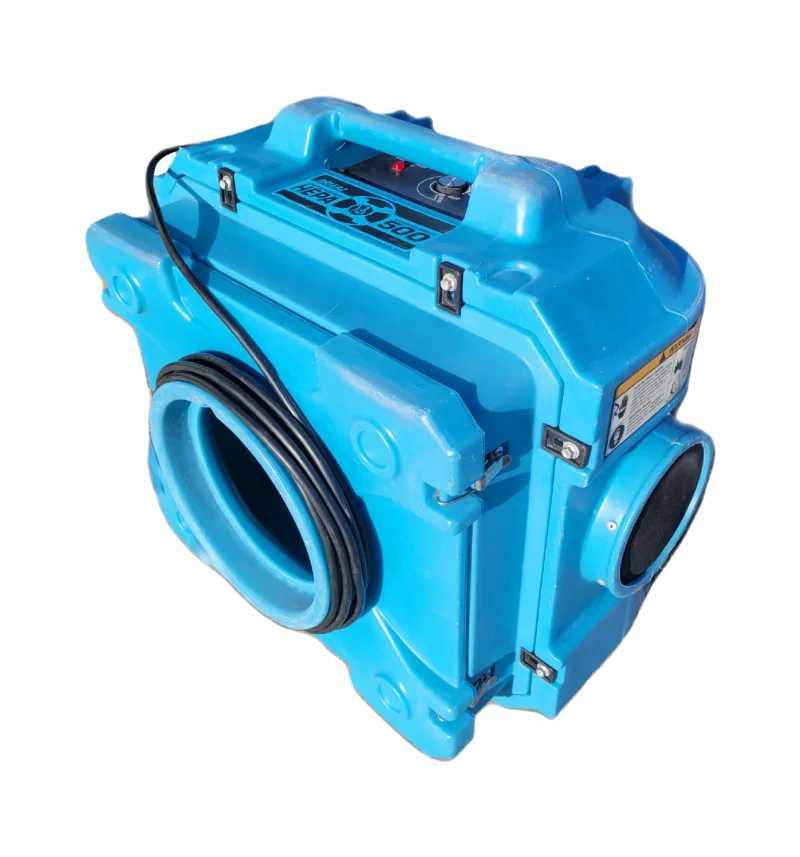
On anything that is already category two, it is the move most likely to make the job worse. Air traveling fast across contaminated wet material lifts what is in that material into the air of the building, and the problem stops being confined to the floor you can see. This is exactly why professional setups pair airflow with filtration and containment rather than running airflow alone.
The rule that keeps you out of trouble: if you do not know what the water came from, or it has been sitting more than a day, do not blow air across it.
What to Do in the First Hour
Short list, in order.
- Stop the water. Main shutoff, not just the local valve, if you cannot identify the source with confidence.
- Kill power to affected circuits before standing in anything.
- Get standing water out. A wet vacuum removes more water in ten minutes than a dehumidifier does in a day, because bulk removal is mechanical rather than evaporative.
- Lift what can be lifted. Rugs, furniture legs, anything moving moisture into or out of the floor.
- Take readings and photographs before you move anything else.
Why Readings Matter More Than Photographs
Photographs record what a space looked like. They do not record how wet it was, and the second of those is the number every later decision refers back to.
A moisture meter measures water content in building material. It costs very little to rent, and it is the only way to know two things that matter: how far the water actually traveled, and whether the drying is working. Both are invisible.
Drying standards define a target condition rather than a duration. Nobody dries for four days. They dry until the wet material reads the same as comparable dry material in the same building, which is why an unaffected wall in the next room is your reference point. Take that reading too, early, before anything is running.
The practical version of this is that a job with readings has a finish line and a job without readings has an opinion.
What the Equipment Does, in the Order It Does It
|
Stage |
Equipment |
Job |
|
Immediate |
Wet vacuum or extractor |
Remove bulk water mechanically |
|
Hours one to six |
Air movers |
Break the still air against wet surfaces |
|
Continuous |
Dehumidifier, pumped drain |
Take the moisture out of the room |
|
Throughout |
Moisture meter |
Tell you whether it is working |
|
If category has moved |
Air scrubber and containment |
Stop redistributing what is in the material |
Sequence matters more than specification. Air movers running before the standing water is out are evaporating water that could have been vacuumed in a fraction of the time. A dehumidifier running with the windows open is dehumidifying Los Angeles.
The Local Variable Worth Knowing
Los Angeles is built across a large elevation range, and its water system is organized into pressure zones to serve that. A supply line failure low in the basin arrives with more force behind it than the same failure on a hillside, so a pinhole leak that would have been a slow seep elsewhere can put a surprising volume of water into a building before anybody notices.
The consequence is that visible area is a poor guide to volume here. Two similar-looking losses in different parts of the city can be carrying very different amounts of water into the structure, and a meter settles it where the eye cannot.
Renting Rather Than Buying, for a Job With an End Date
A water loss needs equipment for a defined and fairly short period, then does not need it again. That is the case rental exists for, and it is why most owners handling a contained loss end up hiring equipment for a water damage response in Los Angeles rather than adding three machines to a garage. Coverage across the metropolitan area is listed on the Google Business Profile.
The part worth getting right is matching the machines to the class of loss rather than to the size of the room. Any supplier worth using will ask what material is wet before asking how many square feet it covers.
What the Second Day Looks Like When It Goes Well
Day one is dramatic and day two is where the job is actually decided, and it looks like almost nothing happening.
You take the same readings in the same places you took them yesterday, and you compare. That comparison answers the only question that matters: is this drying. Numbers coming down means the setup is working and should be left alone. Numbers flat means something is wrong, and it is nearly always one of four things.
The space is exchanging air with outside, so the dehumidifier is working on the city rather than the room. The wet material is under a covering that airflow cannot reach. The dehumidifier has filled its reservoir and stopped. Or a machine got switched off overnight and nobody mentioned it.
Each of those has a different fix and none of them is more equipment, which is the instinctive response and the one that reliably makes a stalled job louder rather than faster.
The other day-two job is checking the boundary again. Water moves through material for a while after the source is stopped, so an area that read dry yesterday can read wet today, particularly under a floor or behind a baseboard. A reading at the edge of yesterday’s wet zone takes ten seconds and occasionally saves a wall.
Where the Line Is
Handle it yourself when the source is clean, the area is contained, the surfaces are mostly hard, and you found it the same day.
Call somebody when any of those is not true, and specifically when the water came from outside the building, when it has been sitting, when it has reached more than one room, or when it went into a wall cavity you cannot open and inspect.
The forty eight hours are not a countdown to a disaster. They are the window in which the cheaper version of the job is still available.

You May Also Like

Why Alejandro Betancourt Believes Accepting Challenges Beats Fighting Against Them
Vandalism-Resistant Restroom Design: What Actually Deters Damage