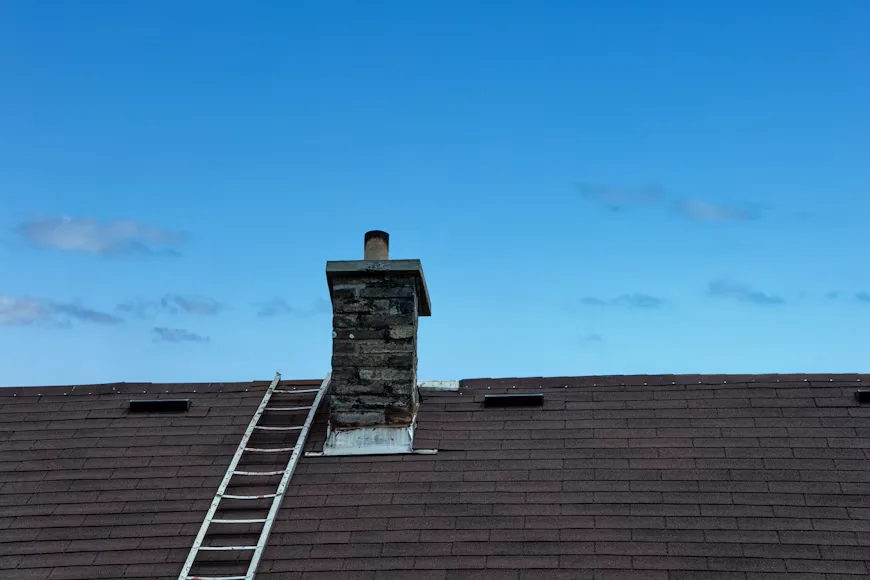
Rust Jacking the Hidden Problem Cracking Homes
Photo By: Martin Martz
When was the last time you had your chimney inspected? If you can’t even remember, you might be missing an important part of your home’s maintenance. Knowing when your chimney needs a checkup can help you catch potential problems before they turn into costly repairs.
“Most homes that are 30 or 40 years old have stucco chimneys,” mentioned Joe Ochal, founder of Chimney Scientists, a chimney repair and maintenance company serving the greater Philadelphia area. A stucco chimney is a chimney with an exterior coating made of stucco, a cement-like material that protects the outside structure.
“Those are usually built as a block structure or a wood-framed chase, wrapped in a vapor barrier, with lath and stucco over the top. A lot of that work was done without good drainage details. No real gap for water to get out, no weep screed, stucco buried at the roofline. Water gets in behind it and can’t escape, and it sits right against the metal,” he added. And even though you may not be able to see the damage at first, it may be worse than you could imagine.
How does it start?
Many chimney owners are unfamiliar with how their chimneys can start to deteriorate or what the term rust jacking actually means.
Having your chimney inspected regularly not only helps prevent rust jacking, which occurs when rust causes metal parts to expand, cracking the surrounding masonry, but can also help protect your health. According to the United States Environmental Protection Agency, particles and combustion gases can come from improperly installed or poorly maintained chimneys and other combustion appliances.
“Most stucco chimneys have a layer of metal lath, basically a wire mesh, nailed or stapled to the structure underneath so the stucco has something to grab onto. When water gets behind the stucco, that mesh starts to rust. Rust takes up a lot more room than the steel it came from, and the mesh is locked inside a hard shell of stucco with nowhere to go. So it pushes outward. That’s rust jacking,” Ochal added.
When these systems aren’t working properly, harmful pollutants can make their way back into living spaces and may contribute to respiratory and cardiovascular problems over time.
This is why keeping up with chimney maintenance is about more than protecting your home; it’s also about keeping the air inside it safe to breathe.
Signals you may be missing
Since rust jacking happens deep within a chimney’s construction materials, we may not be able to see it right away. Sometimes, the only way to know for sure what’s going on is to open up a small section and look at the lath and the structure underneath.
Even so, Ochal shared some signs homeowners can look for to identify a potential rust jacking problem:
“Look for cracks running in straight lines or a grid pattern, because they tend to follow the lath or the trim. Bulging areas, pieces popping off, and stucco that sounds hollow when you tap it all mean it’s coming loose from what’s behind it. Staining or cracking at the bottom of the chimney or around the roofline is another tell. Normal stucco gets small hairline cracks as it ages and shrinks,” he added.
As these signs become more evident, the damage may also become more extensive. That’s why it’s important to take precautions and put the previously mentioned recommendations into practice.
High-tech chimney tools
Many homeowners may think that patching over cracks or caulking them is the easiest solution, especially because it “looks fixed.” But the truth is that the metal can keep rusting behind the stucco, and painting it with a thick coating can make things worse by trapping even more moisture.
Thankfully, as technology advances, so do the tools used across different industries, and chimney repair is no exception.
To address rust jacking, the team at Chimney Scientists uses not only common moisture meters, but also thermal imaging cameras, which help identify potential moisture problems behind stucco by detecting temperature differences on the surface.
According to a study published on ScienceDirect, thermal imaging cameras can also help experts monitor how moisture evaporates from building materials during the drying process. By detecting temperature changes on the surface, this technology makes it easier to track how materials are drying over time and understand whether they may still contain moisture. This can help professionals make better decisions about when a repair can move forward and whether a damaged area needs further attention before the next step begins.
How big is the problem?
Not all rust jacking problems have the same impact:
“It comes down to how much area is wet, how long it’s been rusting, how badly the lath has rusted, and whether the structure underneath is damaged. If it’s a small spot and everything behind it is solid, we can cut out that section, replace it with acrylic lath that doesn’t rust, and fix the water source. If the moisture has spread or the framing or sheathing is rotting, the stucco has to come off down to the structure and get redone with the right details so water can drain out,” Ochal explained.
This also explains why the main advice for chimney owners is not to wait until an emergency occurs, but to keep up with the regular maintenance their chimneys need to help protect their homes.

